Showing posts with label adventures. Show all posts

Monday, 24 February 2014

Museum Night Fever!


Oh, this was excellent fun! They do get this sort of cultural thing right every so often - with a few dud notes, admittedly. Museum Night Fever was a whole evening (plus an after party) of shenanigans in various museums here in Brussels, with a wide range of activities and venues. It reminded me of the Ashmolean's Live Fridays, but GONE CITY-WIDE!


First up, on our evening's agenda, was the Jewish Museum. Well, actually, first up was getting the surprisingly well organised shuttle bus service, which we picked up at the MAF stop near us (more of which later), guided onto the bus by a friendly gorilla in a fluorescent vest. There was a great atmosphere, people all out to have fun, excited about the evening ahead.

The Jewish Museum is a fascinating place. I think we were there a little early in the proceedings - the promised music didn't start until much later - but it's one of the museums which I have been meaning to visit here, and even without any MNF 'extras' I'm glad we went. As is usual in many museums here, the texts are all in French and Dutch, with only occasional handouts with English translations. (I've just realised that makes me sound like one of those 'if I shout loud enough they'll understand, bally foreigners' but what I mean is, tourist-wise, they're not cashing in on the potential for having handouts for everything, and I do find it frustrating when they have some text but not all translated.) But, with or without English text, it was a very visual experience - lots of well-curated walls of photographs and nicely displayed exhibits.


The next stop on our visit was another place we'd wanted to go anyway. We'd both loved the previous exhibition at the Museum of Letters and Manuscripts, of artists' letters, so this - of love letters - was on our list of must-sees. And despite being crowded with people, it was excellent. There was a good range on display, with lots of pulled quotations on the walls, in French, Dutch, and English. The extras for MNF were performances, theatrical pieces, and dramatic readings based on the letters in the exhibit, but on a first come first served basis which excluded the vast majority of visitors. Tante pis. Top left in the collage above is the handwritten text of Je t'aime, moi non plus by Gainsbourg. Bottom left is a letter from Brigitte Bardot to some lucky man. They had letters from Napoleon, Satre, Apollinaire, Czar Alexander II, all kinds of people.

From here, in the Gallerie Royale Saint-Hubert, we wandered through to the Grand Place (beautiful atmospheric lighting at the top of the post), and from there to La Monnaie, the operahouse. And oh, this was the highlight of the evening!


The booklet exclaimed this is not a museum - touch the art, touch the artists! All the activities were themed to 'revolution', playing off the operahouse's 'revolutionary' history as the scene of the riots which put the wheels of Belgian independence in motion. The foyer was taken over by a sound installation, made up of recordings taken at demonstrations round the globe. It was a real aural assault, and it made the arrival by jarring you into noticing something big was going on.

Our first activity was to be 'birdified' by Thijs Van Vuure (photo collage bottom left)! He asked for a volunteer, and I deeply regret not speaking up. The booklet had implied that he would 'birdify' lots of people, but it was actually only one per session. Van Vuure is an artist who has studied biology, and found that birds live their lives ten times faster than we do (their hearts beat ten times faster, their life cycle is ten times faster). He recorded Belgian birds, slowed them down to 'our speed', and then copied the sound that was made. It makes birdsong into a vocal range which is possible for us to imitate, and that's where the volunteer comes in. Van Vuure had built a 'birdhouse', which was actually a recording studio. The volunteer had to listen to birdsong and copy it, and when the recording was finished, he sped it back up to bird speed and it really, really, worked! The girl's singing sounded exactly the same as the bird recording!

We then made our way to another sound installation, this time in the main theatre space itself. ATK! had taken over the seats, with the audience drifting in and out of the space, sitting on the stage, rather than in the stalls. There was an amazing light show, using installed lights and the theatre's own, and noise. I say noise because it was this aspect which really made it. In Hong Kong, the 'symphony of sound and light' uses twinkly, soft, happy music. ATK! used industrial noises and atonal chords, which made for a really creepy experience. It was a little bit as if there was an alien spaceship landing on top of us. In a good way.

After that, it was time for a bit of a rest. There were two refreshment venues, the 'soft room' with tea and cake, and the 'hard room' with revolutionary opera cocktails. We obviously went for the cocktails. They had two, one gin and one rum based, which were perfectly pleasant, but nothing special. The bar was another performance space, and the violin-piano-and-computer ensemble kept us there for a little while. There was also an area for making your own revolutionary posters, with a long line of people eager to 'smash capitalism' and 'free Belgium', but we'd stupidly left this til last, and didn't want to wait for the ink to dry before moving on, so didn't get a chance to create our poster (which would have, we decided, featured a bike and a lightning cloud, from the images available).

Our evening ended on a bit of a downer, which was a real shame. We walked to the Charles Lorraine Palace, stood in an enormous queue, with the Vedett truck blasting out some proper tunes (see top photos), and slowly moved forward, only to be told, upon reaching the doors, that the venue was at full capacity and they weren't going to let anyone else in, and that we had to go away - actually go away. Fine, health and safety and all that, but the fashion show wasn't due to start for another half an hour, and I don't think they could have known that nobody else would leave in that time. Hey ho. Back to the shuttle buses, full again of happy people, and to MAF, our last stop, near to us (so a good final stop logistically), and described in the booklet as an exciting opportunity to visit this usually closed museum. But, alas, we were disappointed. I am not sure what we were expecting but it certainly wasn't this. MAF is the Museum of Fantastic Art. And it was, in a sense. It was fantastic as in fantasy, as in sci-fi, as in steampunk. And it was art as in weird objects and science experiments and bits of skeleton. But - and this was the real issue, I think - not very good ones. I kept thinking, as we walked around, that it was such a shame that such a beautiful maison a maitre had been covered with jelly and mutilated monster babies and stuff. Nevertheless, I would highly recommend Museum Night Fever as an evening's entertainment, and would definitely go again if they have another one. Not all the museums participated, and I think some had a better idea of what to do with an evening's opening than others, but it was such good fun, running all over the city at night, doing cool things and seeing cool things and hearing cool things. And pretending we were cool, too, being part of it.

Sunday, 16 February 2014

I thought every week in Brussels was Chocolate Week


This week was Brussels Chocolate Week! There is no discernible difference between this week and any other week in Brussels. This city is full of chocolatiers, both chain and artisan, with shops seemingly on every corner and no end to the inventiveness of the products.

It happened to coincide, last year, with one of my weekend visits, so this is the second year we've participated. The main event, as far as I can tell, is the 'chocolate pass'. You buy a little book (very well put together, with a map and info about the shops) for 6 Euros, which contains 10 tokens. You then visit the participating shops and are given tasters - what's not to like about that?!

They have tried to market the pass as a 'chocolate walk' this year, which worked on some levels but not on others. So, yes, you can absolutely walk round Sablon, enjoying the picturesque views and the chocolates, and from there wander down to the Grand Place, and get a fair few tasters along the way. But there are also participating shops outside of the centre, which we didn't get to. Although perhaps the idea is that if you walked to Scharbeek you'd have earned the chocolate at the end of it. I felt that this year there were fewer shops participating, and that perhaps they were a little less generous. At least, there was definitely a sense in some of the shops that you were annoying them, coming in with little strips of paper and expecting to get something for free. The assistant at Galler, next to the Grand Place, was particularly sour, and even refused to give us a little bag or napkin to put the chocolates in (chocolates which we did not choose, but were unceremoniously thrust at us as the standard tasting offer), as we wanted to take them home to enjoy later (and to gloat over the enormous pile accrued, natch.). Having said that, there were also shops which were very generous - Passion Du Chocolat, next to the NH hotel on Sablon, gave us two choices each, as did Belvas, and in another shop the assistant waved away the token, saying that they gave out free tasters anyway. In Pierre Marcolini - he is a god amongst men, a genius with salted caramel - they had little bags already made up with two chocolates each, which they also did last year.

It was a pleasant enough way to spend a Saturday morning, and we returned home with a nice haul of chocolates:

Look at that whopper from Cafe Tasse! Shame it's a coffee and speculoos flavoured bar. They probably have a surfeit of them they needed to shift. (Oooh, bitchy!) The little ones to the left of that bar are the three from Marcolini - 'quatre epices' truffles and mystery triangular-ish ones... Wittamer win the best decorated award, with their colourful squares. That one with the green lines on is jasmine tea flavoured! All of the white chocolate ones have been chosen by the Dutchman, which I was surprised by. I've never seen him interested in white chocolate before. Perhaps it is self-preservation, that I can't pretend I didn't know whose they were when I eat them! (Argh, the tense of that sentence...) 

UPDATE: The best most favouritest deliciousest ones thus far have been the circular one with white chocolate decoration, top middle-ish, which was a very dark chocolate shell encasing a soft smooth blackcurrant ganache (from Passion Du Chocolat), and the weirdly shaped dark one, bottom middle-ish, which was filled with a very dark liquid caramel with a slight coffee note (from Planete Chocolat). 

Monday, 10 February 2014

Antwerpen


On Saturday we decided to visit another part of Belgiumland: the beautiful and apparently rather trendy Antwerp. Or Antwerpen, if you're Flemish. We had a cold but mostly clear day, with a strong wind but thankfully no rain. I liked Antwerp. It is an undeniably pretty city, with a large old centre, but there's also a lot of new building around the port (not as good as Rotterdam, obv.) and that's where we started our day.


The Museum Aan Der Stroom is an amazing building. But, although we loved it, we both thought that it had been built rather for itself without much thought to the internal exhibition space. There are a lot of escalators and a viewing platform on the top which gives spectacular views of the city, but as a museum there's a mish-mash of stuff inside. Of the permanent collections, the sections about Antwerp as a world city and as a port were the best. I was particularly enamoured of the floor filled with model ships. I do like a good boat, it has to be said. And the 'interactive' elements were good too - write a message in a bottle, chalk yourself into the skyline...

After marvelling at the wavy-sided walls and 'sporting life' escalator-installations, it was time for lunch. Man oh man, it was goooooood.


The excellently-named Balls & Glory specialise in stuffed meatballs. For 12 Euros you get a massive serving of stoemp (Belgian mashed potato with vegetables in - ours was carrot, pea, and mushroom), two sauces (a rich meaty gravy I would have happily swum in, and a sort of Thai-spiced creamy fennely affair which, whilst good, didn't really go with the rest), and a STUFFED MEATBALL. They sell lots of flavour combinations to take away, but have two choices hot and ready for lunching. The Dutchman went for a blue cheese filled ball, I had a cherry filled one. And god was it good. Breaking into the meatball I released a rush of purply sauce and steam. The cherry sauce was just the right blend of tart-sweetness to complement the meat, and the gravy and stoemp were side elements which shone. And they had lemon water and fruit for free on the tables! The restaurant itself was part of a larger enterprise, with another restaurant and a food market, and was full of satisfied people. We could quite easily have had a nap, but it was time to move on and see some more of Antwerp.

There are two churches which regularly feature in 'top ten things to do in Antwerp' lists - the mighty Cathedral and St. Charles Borromeo, whose interior was designed by Rubens. The Cathedral - which dominates the skyline and the old town - was closed for services (bloody Catholics) but we kept catching glimpses of it above the houses and it loomed at us round corners. St. Charles Borromeo, on the other hand, was a glorious Baroque masterpiece, gilded and cherubed all over, with a huge Rubens altarpiece depicting many fat cherubs and women of ample bosom. (The Rubenshuis, which I want to go into, was closed by the time we got there, unfortunately, but that just means that we'll have to go back!)


As the evening drew in, we wandered around the old town (that's the Cathedral, top and middle left). We spied a square with these lovely trees strung with lights, and then the Dutchman remembered that there was a cocktail bar through an archway which of course demanded a visit. Cocktails at 9 (which also has rooms) was a lovely little place to stop. I loved my Rose Garden cocktail - made from gin infused with cardamom, elderflower, rose, and some other things I've forgotten - and I also loved the laid back feel, with cosy armchairs and hipster barmen who didn't impinge. We had dinner in a restaurant close by, a typically Belgian feast with excellent chips and, for me, the perfect Flemish stew: beef cooked until fork-tender in dark beer with nothing else but a bay leaf or two. We drank the Antwerp beer, De Koninck, which was strong and caramel-malty and very very good.

We headed back to the station - an awesome cathedral of the rails to rival St. Pancras (photo top right) - with a quick detour to peer into, first, the eerily-silent locked gates of SintJacobs Kerk, where Rubens is buried, and second, the rather impressive zoo next door to the station. It was a lovely day out, much fun was had by all, and I would love to go back. Clearly my reasons for returning would be cultural and not purely based on my desire for more stuffed meatballs or delicious cocktails. Ahem. No, I am a big fan of Rubens, and want to see where he lived, is all...

Saturday, 28 December 2013

Christmas in the foreign: Brussels and Maastricht


We came back from New Zealand on a late Eurostar, arriving at Midi in the dark, laden with baggage. It was cold. It was early December. We’d been eating asparagus and drinking chilled white wine in the sun only a couple of days before. But, jetlagged as we were, there was something which perked me up on the taxi ride home: the Christmas lights. Brussels, I salute you, you Continental types do know how to decorate. Each area seems to have its own designs. All white, all quite understated, but all the central area, the major streets, and quite a few others, had lights up. It made the fact that it got dark at 4pm a little easier.


Two visitors – my friend A and my mum – also made the pre-Christmas-weeks fun, as we shopped for Christmas presents together and did the touristy things which the Dutchman and I don’t do on our own. Last year, before I was living here, I had a brilliant weekend trip with H, drinking hot chocolate and laughing at the Christmas market (one of my abiding memories is the looks we got for opening a bottle of Prosecco on the Eurostar on the way over…!). The Brussels Christmas market was a little disappointing. There was not much that one would actually want to buy. I think we were all expecting the kind of German market that gets shipped over to Oxford and most other English cities, with pretty little wooden huts and nice artisanal products. Eh, not so much. A shame. I enjoyed walking through the streets and just looking, A drinking mulled wine and I warm spiced calvados to stave off the cold. Next year I think I would like to go to Frankfurt or Cologne.

The other Christmassy thing which I loved here was the crèches in the Cathedral. All created by different ethnic groups or associations, dotted around the Cathedral by various chapels. There were some really beautiful, well-made ones, some amateur some crafted by artists, and most kept their identity as a focus – the Nativity in China, in Africa, in Haiti…


To inject a bit of Englishness into the proceedings, I made many mince pies, with the mincemeat my mother and I made back in October. We gave some to our landlady, took some to the Dutchman’s parents for Christmas Day, I will make more as our contribution to the annual Rotterdam Christmas meal with the Dutchman and his friends, and of course I ate a fair few. We still have the boozy, fruit-packed, darkly crumbly Christmas cake too, again made back in October and fed by my mum right up until the week before, but it doesn’t photograph well, especially sans marzipan and icing, at the Dutchman’s request.


We were in the UK before Christmas, briefly, for my PhD graduation (on my birthday!) and to see family. We woke up together on Christmas morning, had our stockings (delivered by Father Christmas, even though one of us had already had a visit from Sinterklaas in early December), went to church, had a delicious lunch of spiced apple and parsnip soup, and then travelled to Maastricht. The Dutchman’s father made a simply outstanding meal (five courses, very nouvelle cuisine, all well-executed) and we exchanged presents. On Boxing Day (the reason behind the name of which I have explained to many, many people) we had coffee with the Dutchman’s very sprightly 94-year-old grandmother and then came back to Brussels. I can’t deny that I missed my parents and our family traditions, but I was happy to have had Christmas together.

Wednesday, 11 December 2013

Behind the Scenes at the Museum

Well, at the Opera House.


When my lovely friend A came to visit last week, we finally acted on a tip given to me over a year ago by Belgian Waffle, to go on the ‘behind the scenes’ tour of the Opera House, La Monnaie (De Munt). We were completely unprepared for what this dull Saturday morning had in store for us.

La Monnaie is responsible for Belgium. For a hilarious history lesson, see Belgian Waffling’s post here, but the short version is that riots started during an opera led to the creation of this independent nation. (The Dutchman is convinced that if it still belonged to him, the roads would not be in such a poor state, but I digress.)

The tour starts in a way rather unassuming way. You are not in the Opera House, but the building behind it. This is the first surprise. The tour begins in the ateliers, the workshops. In fact, most of the tour is here, only heading over to the actual Opera House for the final twenty minutes or so. We were not complaining. (Tours are run in French, Dutch, and English if the audience is there, but we found that our guide often forgot to repeat herself in English. Never mind, we had plenty to occupy us.) The guide began her talk in front of row upon row of costumes for Hamlet, the latest production. We were given a bit of history, but swiftly moved on to talking about the work that is done here, and the production teams which work year round to supply costumes, sets, and props for the shows.

First stop was the painting studio, and the various workshops for set design:


Chaotic but obviously dedicated, this is a side of theatre production that one doesn’t often see. I loved the fact that the plans were lying about, that one could see the names of famous operas casually scrawled on the backs of flats, and that all that magic comes from paint, wood, metal, and hard work. Perhaps the most amazing aspect of this area was the 'assembly room' where they check the sets before taking them across to the Opera House itself (bottom left photo above). A cavernous space, marked all over with measurements, the industrial look is about as far removed from the final setting as you could get.

My favourite part of the tour was wandering through the costume department:


There were rows of sewing machines, boxes and boxes of bits and pieces, bolts of cloth, and notes everywhere. After walking through the rooms where they make the costumes, we saw the storerooms - an archive of previous operas and other productions. The guide told us that the costumes and props for one opera are 'copyrighted', as it were, to that specific production, and cannot be reused for any other production. Apparently they auction off the surplus every so often, when they run out of space.

I also loved the little in-between spaces, where props from old operas had been used to decorate the spaces: a giant bookcase from Don Quixote near the lifts, costume sketches on the walls, and those beautiful wings hung up like coats.

The last stop in this building was to see the miniature theatre, an eighteenth century copy of the theatre at Bayreuth:


Our guide also gave us a ‘show and tell’, which added to the experience, but made me feel a little like we were a visiting school group. We handed round a severed head modelled on a famous singer for a role where he was executed and a make-up artist’s notes for travelling productions. It was certainly interesting and a nice addition, but I think it would have been hard to impress us after being allowed to walk freely through the workshops (especially for me, who once harboured the desire to be a Theatre Designer). Time had really flown, and having started the tour wondering if we would actually see the Opera House, I was quite disappointed to leave the ateliers.

We entered the Opera House through the artists’ entrance, a stark contrast to the plush velvet-and-gold main entrance. Like the workshops, the Opera House was mostly empty, giving us the space and time to appreciate it in a way I don’t think you would when filled with people. For example, the sweep of the staircase and expanses of rich carpeting are more impressive when you can see the full scale. Inside the theatre itself, we sat in the ‘best seats in the house’, centre of the front row of the balcony (I think the sight line is called something like 'the Prince’s Line'). We also stepped into the Royal Box – the worst seats in the house for actually seeing the opera!

View from the Royal Box - looking out to the audience, not the stage!
(Please excuse terrible phone photo.)
The tour made me want to see a production at La Monnaie, but it also made me want to explore the backstage areas of other theatres. I don’t know how well-known this tour is, but I honestly think it’s one of the best experiences I’ve had in Brussels. Especially when followed by a massive cone of frites with mayonnaise.

Wednesday, 4 December 2013

The Other Side of the World (2 of 3): New Zealand - North Island


Whangarei - Bay of Islands - Matakana - Leigh Coastal Walk - Coromandel Peninsula - Mount Maunganui (Pacific beach) - Rotarua and Tamaki Maori Village - Wai-O-Tapu Thermal Park - Lake Taupo - Tongariro Alpine Crossing - Napier (Art Deco town) - Gisborne (Cook's First Landing) - Lake Waikoremoana - Cape Kidknappers (Gannets) - Martinborough (wine) - Wellington (Te Papa, Old and New St. Pauls, Botanic Garden via Cable Car - Soames Island trip)

Water
- The Whangerai Falls were the first thing we saw on our first full day, involving a hike through lush, dense bush, walking across a swinging rope bridge, and emerging at the base of the falls.
- A boat tour through the Bay of Islands was the best way to explore this area, including seeing a whale and going through 'the hole in the rock'. The weather started cloudy and grey and brightened to beautiful blue skies with scuds of white cloud, and then ended with a moody storm.
- Wai-O-Tapu Geothermal Park was full of exciting things like boiling mud, 'champagne' pools, and weirdly coloured water (due to mineral deposits). Plus the Lady Knox Geyser they set off every morning!
- We attempted to do a short hike round the waterfalls which lead to Lake Waikoremoana, but after a few lovely vistas the heavens opened with hail the size of golf balls. Cue hasty retreat to the car.
- Other days had better weather - for example the day I swam in the Pacific Ocean for the first time ever!

Town & Country
- What can I say about the Tongariro Alpine Crossing? It was simultaneously one of the best and worst things I've ever done. The Crossing is a 19.4km hike up a volcano (the route taking you up the charmingly named 'Devil's Staircase') and then ACROSS THE CRATER EDGE and down the other side, through ankle-deep volcanic ash and then, further down, woodland (which involved fording a stream - a great way to find out if your boots are waterproof. Or not.). You should get spectacular views across the countryside, and also amazing views of the volcano and its blue lakes. Well. When we did it, it was not so much that it was raining, as that we were INSIDE the clouds. It was foggy and wet and cold and horrible and we basically did the entire thing without stopping, in five hours. I'm quite proud of myself!
- Wellington was windy but so much fun! The Te Papa Museum is enormous, full of interactive bits and pieces and a wealth of information. We did a walking tour of the city, including going up the cable car to the Botanic Gardens, and happened across a memorial service at the 'Beehive' government building.
- Makatana, oh Makatana. You are the most hipster place I have ever seen! I love you and your antiques and crafts market, but I love your food market more. We ate: an excellent pie with cream cheese pastry (ever so flaky), a whitebait fritter (allegedly a great delicacy), a massive caramel brownie (aw yis), and drank fantastic coffee and smoothies (but no craft beer, because the Dutchman was driving, solidarity and all that).
- The wine tasting in Martinborough was a lovely day's activity. There are many vineyards within walking distance of each other, so we had a nice tour of cellar doors. Everyone was friendly, we tasted some excellent Riesling and Sauvingnon Blanc, and a surprisingly amount of red wine. We stayed in a rather nice B&B that evening.
- Napier and Gisborne were the other two towns we visited, when not tramping through bushland. Napier is famous for its Art Deco architecture, having been completely rebuilt in the 1930s following an earthquake. It made for a nice morning's walking. Gisborne was a little disappointing. The town is the site of Cook's first landing, which is commemorated by a few statues, but little else. There was an excellent museum about encounters between Maori and Pakeha (Europeans).

The Unexpected
- We saw our first Kiwi at the Kiwi North sanctuary which was an amazing experience!
- One Gannets at Cape Kidknappers
-I also loved the impromptu trip we took from the Wellington City & Sea Museum, consisting of a guided tour by a curator and then a ferry ride to Soames Island, an amazing island with a sad history of human quarantine - although they called it the 'Ship'n'Chip' tour which is clearly missing a trick; 'Fish'n'Ships, surely!
- Another highlight was the Maori Cultural Evening we attended near Rotaroa. You arrive on a bus, which is your tribe for the evening, and are treated to a welcome ceremony and taken on a tour of the 'village' with various activities - such as learning the Haka, as the Dutchman did! - before dinner is served. They cook the meal in a hungi, a pit, which produces some of the most tender smoky chicken I've ever had, plus kumara (sweet potato) and carrots, all served in enormous portions. It was, as one of our table said, a bit like Christmas!

Tuesday, 3 December 2013

The Other Side of the World (1 of 3): Hong Kong

New Zealand is about as far away from Brussels as you can get. It is FAR. So far, that the aeroplane has to stop to refuel half way there. We took the opportunity to have a brief stop in Hong Kong: two days of jetlag and eating.

First impressions do count, but I don't know if I would feel any differently about Hong Kong if I experienced it without a massive TIME HANGOVER. It was muggy, it was noisy, it was crowded. I really enjoyed my time there, but two days was enough. The novelty of the Mid Town Escalators hadn't worn off yet, and I was still curious about the market stalls on the street selling more varieties of fermented um, things than I knew existed.


We had no idea what time our bodies thought it was, and although we were shattered, we didn't want to waste any time. The first we did as tourists was ride the Mid Town Escalators to the port (I love the translations of the rules - do not wail against the flow is good advice for life!), to catch the Star Ferry to Kowloon. There we visited the Temple Street Night Market, which was a riot of neon signs and all kinds of stalls (fake bags, ornate chopsticks, mobile phone cases, bunches of herbs). We ate dinner in a tiny place, with no idea what anyone was saying or what we had ordered to go in our noodle soup. After that, the night had really fallen, and we headed back to the dock to see the 'Symphony of Lights'. We'd already seen the impressive skyline of skyscrapers, which light up the horizon, but the show was much-vaulted in the guidebooks, so we were prepared for something spectacular. To be honest? It was a disappointment. Nothing really happened that was any different from the usual night scene, apart from green lasers haphazardly running across the sky. It was the skyline itself which was impressive - see the photo, bottom right, above - with all the lights and the sheer presence of the big name brands and banks, not the 'show'. We stayed in the cool air for quite a while, though, talking about what to do next. I had one non-negotiable trip in mind. Tea at the Peninsula hotel.


The Dutchman and I got dressed up and tried to look as if we were rich enough to do this every day. Tea at the Peninsula is regularly included in lists of 'the top ten things to do in Hong Kong', and rightly so. Ok, so it isn't in any way traditionally Chinese, but it is traditional: the British influence is still present in Hong Kong, with the trappings of the colonial era nowhere more present than in the ritual of high tea. It was spectacular, both in food and location. I had delicate jasmine tea, whilst the Dutchman went for an Assam. We had a selection of little savouries, including an open cucumber sandwich which was perfectly seasoned and a bite-sized salmon quiche. The scones - one fruit, one plain - were enormous. The cakes were easily the best part (aside from people-watching!) and two gave a nod to Chinese cuisine: slices of green tea cake heavy with plums; cassis and tapioca squares. We both liked the pink confection best - see that swirl of pink in the glass? That's whipped vanilla cream and raspberry marshmallow, hiding fresh raspberry purée. (I also took photos of every meal we ate on the flights. Not nearly so interesting.)


Another 'top ten' experience was riding the cable car slash tram up to Victoria Peak, which gave spectacular views over Hong Kong island and across the bay to Kowloon. On the way back down, we passed the Foreign Correspondents' Club, which made me imagine Ernest Hemingway and Patrick Leigh Fermor drinking gin in club chairs. Not that either of them did that here, but, you know, I love the stereotype of the FCC. We did a lot of walking, wandering about the various neighbourhoods: the 'entertainment district' was rather seedy, but it was fun to look around; the Dutchman ran round the tiny Kowloon Park about fifty times whilst I read the guidebook and plotted dinner destinations; we stared up at all the major banking buildings in Central. The one thing we didn't see was much dim sum. We'd been expecting enormous feasts of little packages of steamed and fried deliciousness, but it seems to be such a 'breakfast' thing that we didn't catch it in time. (This was my fault, being an ignorant Westerner, who baulked at the idea of eating 'dinner' in the morning. Somehow I couldn't face rice and noodle soup that early in the day. I needed orange juice and something bread-like.) But oh the char siu pork! The hoi sin roast duck! The five spice beef brisket! The explosion of spring onions on soup! The slurp of noodles from a bowl!

I wasn't sad to leave Hong Kong, because we were headed to New Zealand - rather than the end of the holiday, it was the only the beginning! If we'd stayed longer I would have liked to have seen the Buddha on Lantau Island, but apart from that it was an excellent stop off.

Sunday, 20 October 2013

Art Nouveau

Huis G. Hele / Maison de la Francite & Charlier Museum
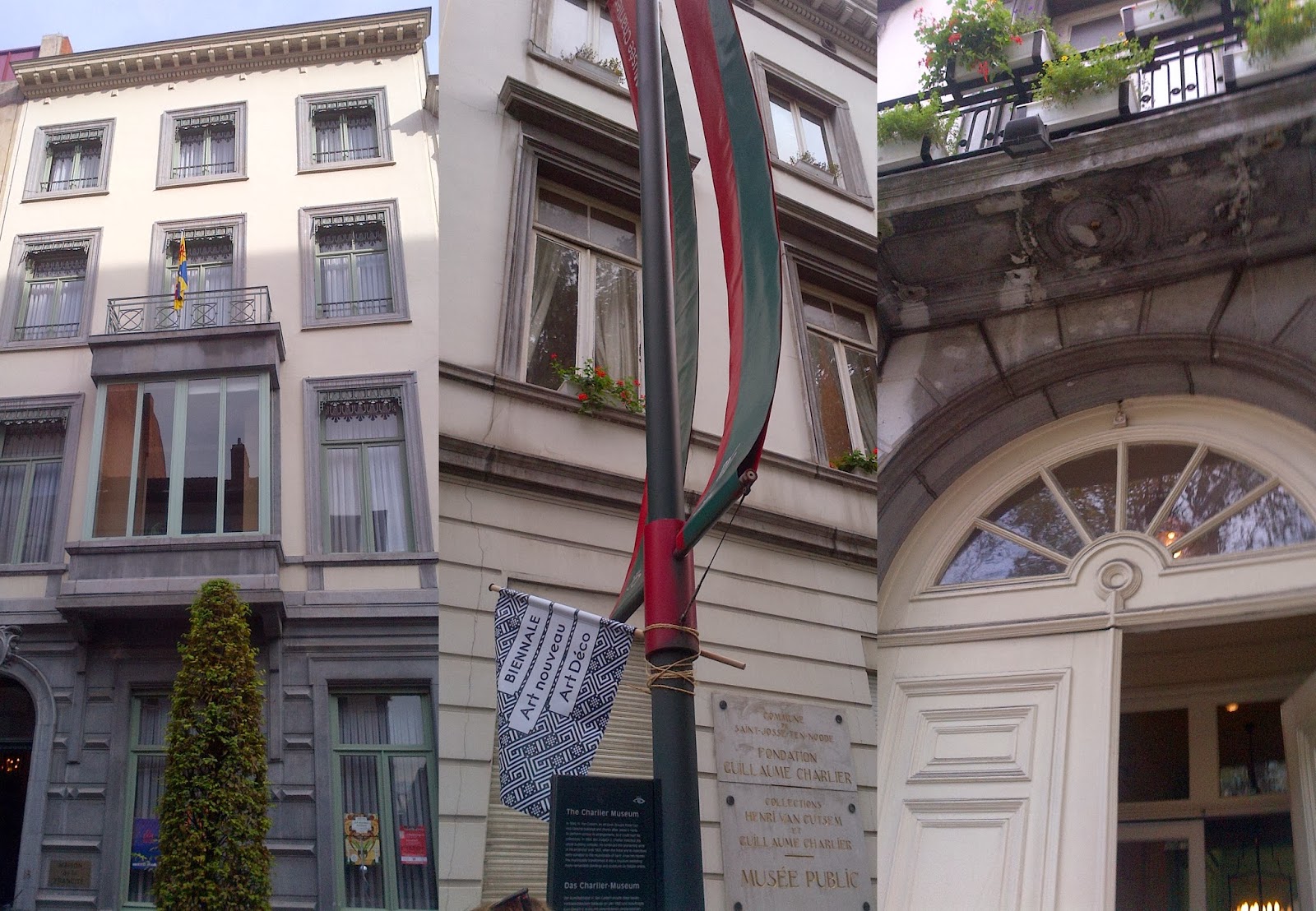
 October sees the Art Nouveau Biennial in Brussels, where many private houses are open for guided tours, as well as museums and other public buildings. Victor Horta's distinctive style is everywhere in Brussels, one of the things I love about the place. The tall 'maison a maitre' houses are all very elegant, very - how should I say this? - European, but Horta's beautiful organic shapes stand out. There are two near us - an always-closed photography museum, Espace Contratype, and the 'Horta house' museum. We visited two other houses of the Art Nouveau tradition this weekend, with the Dutchman's parents.

Huis G. Hele / Maison de la Francite


In my dream home, I would have those stained glass French windows (top left and top middle). I think they are perfect. One of the things I didn't realise was how light it would be inside. Apparently he loved light. I'm used to tall ceilings here, but the combination of large windows and space was notable. We had a tour in English, but to be honest I would rather have just wandered about. There was colour and pattern everywhere - murals on the ceilings, marquetry and mosaics on the stairs, and plenty of stained glass. This building now houses a Francophone community organisation, and the chances to peek into the modern rooms was an added bonus - how do people live in these spaces, without turning them into monuments?

Charlier Museum


This tour was less successful, perhaps because the museum wanted to promote their exhibition of Indian paintings more than they cared about the Horta connection. But they should! Because this was one of the first commissions he had (outside of Ghent) which shows the beginning of his particular brand of architecture. I got the impression that it was sort of a pity appointment by Henri van Cutsem. The house was originally two separate buildings, and has a story to tell which explains one of the reasons for all that light. The large green room - the main exhibition space - was created by knocking the back rooms of the houses together, creating an odd shape that Horta celebrated in his glass ceiling. (The two photos top right show the back of the two houses, looking pretty cobbled-together, whereas you can't tell from the front and inside that they were once separate.) But why the glass ceiling? Because what do you need, if you're an art collector? Wall space. So Horta designed and built huge expanses of flat wall space, with no windows to get in the way of the paintings. Practical and beautiful. Most of the house was decorated as it would have been when completed, in the 1890s, which is to say, it is full of the van Cutsem family's antiques and does not look at all as if it was designed by Horta when you're inside.

One of the most obvious traits of Art Nouveau is the fluidity of line - window tops are often rounded, not square; the wrought iron designs on balconies are rarely straight; bannisters and other wooden elements are manipulated and smoothed out... But what Horta does with his architecture is take it one step further. His houses are as 'organic' as possible: he wants the different elements to blend into each other, not stand apart. So where there are metal bars on the windows, they meet the stone walls with some sort of rounding or protrusion to obscure the join. The one I like best, though, is the way he rounds off the edge of the building, where it meets the street:

I wonder if the people at Espace Contretype get sick of Horta-tourists?
There is no right-angle join but instead an attempt to smooth the transition from pavement to wall. It's these considerations which make the buildings. Yes, I love the stained glass and the organic shapes - and there are far more beautiful examples of Art Nouveau decoration than these two houses - but what I liked about the Biennial was the history behind it, the stories of why Art Nouveau is like that, and it's pretty much all from Horta. The first time something being the Belgians' fault has been a positive, in my opinion.

Thursday, 3 October 2013

Autoloze and Brocante

There is no explanation for this sculpture.
It was Car Free Sunday here in Brussels this weekend, a day when public transport is free (try explaining that to a Japanese family desperately attempting to shove their metro cards into the machine) and the streets are full of bicycles and junk. The Belgians love a good flea market. Any excuse, and they’re out there, displaying their worldly goods on bits of carpet or tarpaulin. Car Free Sunday is a wonderful idea to raise awareness for greener transportation choices – as well as public transport being free, cars are actually banned from the city centre, and you need a permit if you do want to drive – but the lack of vehicles on the roads also allows communities to use the space for other things…


These images all come from our walk down Rue de la Page and around Place Chatelain (where the top left photo with the hamster-esque plastic balls was taken), from where we continued across the eerily silent Avenue Louise (a major route through the city, with about six million lanes of traffic) to Place Flagey, where the usually busy Sunday market was heaving with people. On the way back, we passed a tram moving slowly and sedately along Avenue Louise, accompanied by bicycles of all kinds with riders of all ages in some sort of pro-cycling parade. I wish I had photos of some of the groups we saw, but my Blackberry camera is not too happy with moving images.


The variety of STUFF on the streets at times like these is amazing. ‘Brocante’ appears to apply equally to both ‘vintage collectors’ items’ and ‘stuff that is broken so I don’t want any more but you might’. People appear to use it as an excuse to clear out, and I do wonder if they ever manage to sell these things. There are antiques dealers as well, and stalls which look a bit more professional (perhaps specialising in something), but my experience is that if you’re going to sell something, the weirder the better. Some of the more ridiculous offerings – limescaled kettles without lids, wickerwork baskets with massive holes in, piles of beaten-up trainers – are not included here, but I hope these photos capture the idea. I love the old house number plates, that combination of blue and white seems so French to me. But alongside those? A tangle of screws and odd brackets. Various bits of ironmongery, including door locks. A single wooden coathanger. I did see a beautiful Singer sewing machine table, but alas it was already sold. We could have consoled ourselves with all the Johnny Halliday CDs one could want, but, instead, we visited Lilicup for a beautiful lemon and lavender cupcake (eaten walking back across Chaussee de Waterloo with no cars to be seen in either direction):


Sunday, 15 September 2013

To Dutchland!

Two lovely things already this weekend, and later today we're going to this!

On Friday, we went to the Dutchman's friend's wedding in Rotterdam. It was an evening event, with a Baptist-esque ceremony - all in Dutch, so I had very little idea what was going on for an hour - complete with a band with bongo drums and electric guitar. The reception was fun, lots of drinking and pretending to understand conversations, a capriana bar, and a salsa workshop! There was no sit-down dinner, but I did eat a deep-fried meatball croquette thing, which was an experience I won't be forgetting in a while. The cupcakes were chocolate sponge with vanilla cheesecake and vanilla sponge with strawberries baked into the middle. Obviously I tried both, to be able to give a full report.


That night we headed on to Amsterdam, to stay with the Dutchman's brother and his girlfriend. (They live at the top of a house right on a canal - a beautiful flat with gorgeous views, but man were the stairs steep!) The reason for going to Amsterdam was to visit the Rijksmuseum.


Oh, oh, oh, I was not disappointed. It is a beautiful, imposing building, which they have completely re-done inside. It's all white walls and clean lines - which reminded me, although I know I'm being massively parochial, of the way they re-did the Ashmolean. There's a cycle tunnel through the middle of the building, which breaks the ground floor in half, but also gives, along with the skylights, a lot of light to the internal space.

What I liked most about the Rijksmuseum was the Masters' Gallery, where the Dutch Golden Age is celebrated. The walls above the paintings are covered with murals naming famous painters, and it was quite marvellous to see famous paintings in the flesh. However, what I also liked was the fact that it is obvious, at a glance, where the most famous paintings are, from the crowds huddled round - see above photos of this for The Nightwatch and the Vermeer hangings. We had so much fun. Not only did the Dutchman get involved, at my behest, with a militiaman painting, I also got a lot of strange looks for posing, pretending to weep, in front of the stern carving of the Royal Charles, captured and pulled triumphantly back to the Netherlands by the evil Dutch as their prize for winning the Battle of the Medway. Unfortunately this photo has now been lost because I stupidly thought that if the camera said it had finished uploading it would have actually finished uploading and therefore did not check before deleting the photos off the camera. Cockfetch. Memories of tasty oude kaas (literally 'old cheese') sandwiches and Dutch Apple Pie are comforting me.

I love Rotterdam, because it is where the Dutchman studied and where many of his university friends still live. When we go there it is always for a social occasion, and I've always had an excellent time. I like Amsterdam (despite the fact that it has been tipping it down on both the times I've been there), with its pretty canals, but I definitely feel like a tourist, and have still got so much to see. We must go back to the Rijksmuseum, as we didn't get a chance to see the more modern exhibits, and I want to go to the Anne Frank house. I love Dutchland, it's laid back and friendly and full of interesting things. Including my boyfriend. (Boom.) If you're interested in Dutch art, or the infamous ten year renovation of the Rijksmuseum, I highly recommend Andrew Graham-Dixon's BBC documentaries, The High Art of the Low Countries (in three episodes) and A Night at the Rijksmuseum.

Tuesday, 10 September 2013

Library Adventures!

No, please don't run away. I did honestly have some library-based adventures. This is the Belgian National Library - or the Koninklijke Biblioteek van België, if you're the Dutchman - and is where I'm spending a lot of my time at the moment:


They have a courtyard garden (top right) and a terrace (bottom left), overlooking the square (bottom right). The library is set on the Kunstberg, the 'Art Mountain', upon which many of the major museums sit, next to the Royal Palace. It is an interesting building. Modern. Open-plan reading rooms. So different from the Bodleian and my beloved Duke Humfrey's Library. The lockers are all named after famous Belgian writers and such.* I can't get over the fact that they don't let you (!!!) choose your seat (!!!) - you hand in your library card to the woman at the reading room entrance and she hands you a number, seemingly at random. This is now where you must sit. As a creature of habit (always always 248 in the BL, H11 in DH) I find this strange. What if you like more or less light, to sit near the window or away from the doors? Bah. Anyways. This is not the adventure. Adventure number one is the ALLOTMENT ON THE LIBRARY ROOF.

(* Apparently Poirot and Tintin don't count. I deliberately started my attempt at a nice arty representation of this at Georges Simenon, as one of the few I knew. That either makes me very uncultured or these Belgians not that famous. Probably the first. Me and Maurice Gilliams are becoming very well acquainted.)

Potager


There is an allotment on the roof of the library. An actual allotment. With a biodome and vegetables you can buy. It is amazing. I basically slunk round, took these photos, and left, but I sort of regret it. There were three distinctly hippy types weeding and talking to people, and I did want to know more. I saw tomatoes, potatoes, peppers, chillies, beans, and various herbs, and the signs indicated others would grow in season.

And then on my way back down, I had adventure number two...

The Librarium


I have no idea whether I should have just wandered in, or whether I should have been allowed to take photos, but I am glad that I did. The Librarium is a kind of museum of the book. The sculpture at the entrance is made up of pieces of paper with words such as 'library', 'book', and 'reading' written in many different languages. It's a striking piece. I've seen it out of the corner of my eye when on the way to the reading room, but today for some reason it was more brightly lit (although I was the only one in there).

Exhibits track the history of books and manuscripts, from stone tablets, scrolls, and early printing, through to innovations and curiosities such as miniatures and pop-up books. What I liked most about it (apart from the eerie quiet) was the way technology had been integrated.


Touchscreens abounded: display case information; a booth where they show a different illuminated manuscript every month, with 'turnable' pages; ipad-esque video screens for choosing your language and subject...

Every day I walk from our apartment to the library, set out my books, and make notes hoping to cover all the possible things I could be asked in my viva. I am attempting to allay the panic with a vast pile of books and highlights and notations and quotes. I'm not sure it's working. But today, today felt good. An allotment on the roof and a wunderkammer in the basement. Belgium, you continue to surprise me.

Thursday, 5 September 2013

Mosel Valley: Riesling, kuchen, more Riesling, and sights.


The Dutchman and I decided to celebrate out first weekend of living together in Belgium by leaving the country. We had such a good time in the Ahr Valley in the spring that we thought we'd try another German destination - the Mosel Valley. The fact that we both love Riesling might also have something to do with it...

We started in Trier (where Karl Marx was born!), visiting the Porta Nigra and generally wandering around the pretty streets, and ate a fantastic Schwartzewald Kirschtorte (Black Forest Gateaux) at a konditorei (traditional cake and coffee house) overlooking the Dom (cathedral). (That's enough brackets.)

That night, we stayed at a hotel on the edge of a forest, in the company of a group of very loud Dutch bikers. The wild game goulash - made by the owner's grandmother, who was about 85 and still going strong - was phenomenal, but sadly not very photogenic. We went for a walk into the forest after dinner, just to see exactly how dark dark can get. Result: pretty damn dark. Also eerily silent.

Our second day started with a mosey along the Mosel (LOLZ) from Cochem, in beautiful weather. I do enjoy a nice boat. I also enjoy cake. Success on both counts in Cochem. The banks of the Mosel rise quite steeply in places, but every available space has been utilised for vineyards. We took a walk up into the hills which afforded wonderful views of the river (and a chance to walk off some of that cake).

Choosing to stay at Weinhaus Halfenstube was an excellent decision. The staff were lovely, the food was delicious, and the 'idyllic terrace' aptly named. Staring out over the river certainly made working on holiday feel less taxing! We opted for the 'small wine tasting' on our first night and received four different white wines from the region - we could have gone for a mixture of red and white, or specified the sweet rather than the dry end of the scale - which were the perfect accompaniment to the four course house menu. The first trocken Riesling was so good we ended up taking some home with us! Ditto the rotweinpfirsichmarmelade - a jam made from the so-called 'red wine peach', a fruit the size of an apricot but with bright red flesh. Other delights included the two-course breakfast the next day, sat out on the terrace again, and our lunch of 'Mosel tapas' including potatoes with blood pudding and apple, a wurtz salad that was way more wurtz than salad, and an obscene amount of rye bread and butter. In fact, it's a good job we had such good weather for hiking and cycling, with all that. Om nom nom!

The morning of our last day was spent cycling along the river path from Seinhem to Zell and back, and wishing we could stay longer. For much of the length of the valley the roads hug the river, making it a very pleasant drive - at least for me, as the passenger! I would definitely go back, perhaps to the northern end, where the Mosel meets the Rhine. And now we are back in Brussels, where we are having an été indien and I am looking forward to shopping at the Chatelain Market, feeling small in the massive National Library, and generally getting up to Belgian shenanigans.